How a $4 Trillion Korean Casino Became the World's Crystal Ball for AI Panic
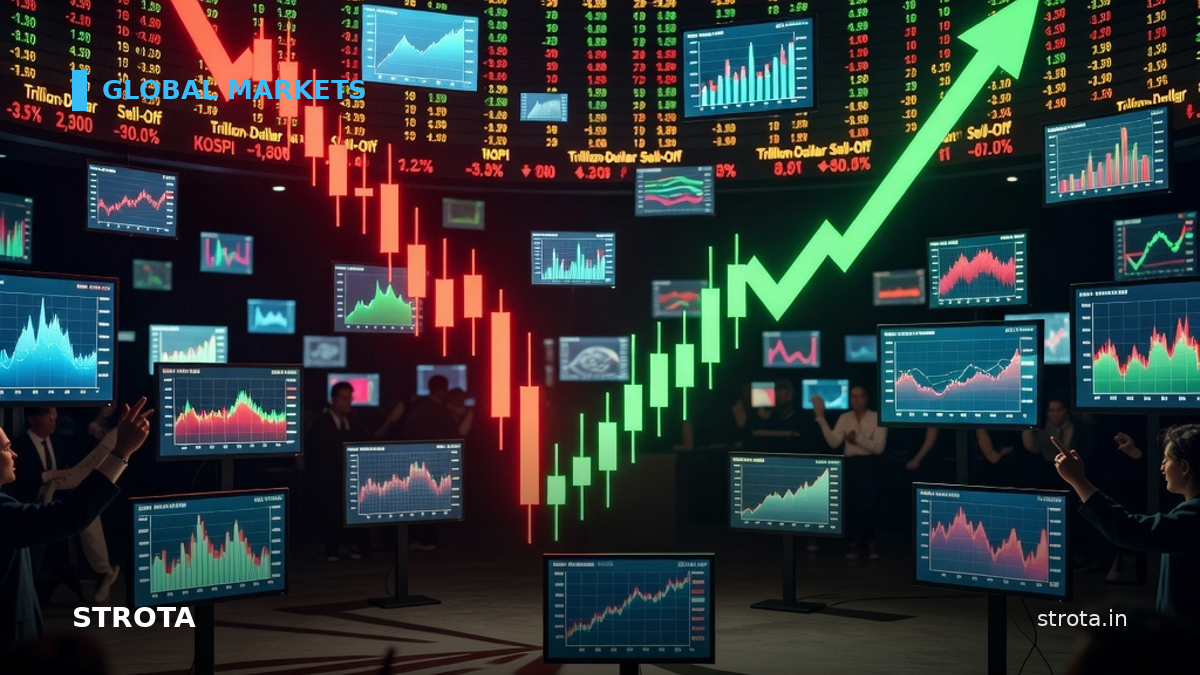
Imagine waking up to find half your retirement account tied to two companies you've barely heard of. For millions of Korean retail investors, this isn't hypothetical. It's Monday morning.
The Korea Exchange has become something its critics never intended: a $4 trillion fortune-telling device for the entire world's technology obsession. And lately, that crystal ball has been shattering.
The math is stark. Samsung Electronics and SK Hynix — memory chip giants that power everything from smartphones to artificial intelligence data centers — make up just over half of Korea's benchmark Kospi index. When they move, nothing else matters. In the past month, both stocks cratered more than 30%. The Kospi followed them down nearly 4% in a single session, at one point plunging 10% in a rout that CNN Business described in real-time horror.
This isn't supposed to happen in developed markets. Diversification is the religion of modern investing. But Korea's market structure has turned that wisdom inside out. The country's retail investors, famous for their appetite for leveraged bets, have created what some observers call an 'open casino' — one where the house always wins until suddenly it doesn't.
The contagion doesn't stop at Korea's borders. It never does anymore.
Wall Street felt the tremor immediately. Nasdaq futures tumbled nearly 2% as Korean markets opened. The S&P 500's record run stalled. Chip stocks across the Pacific — Nvidia down 3.9%, Micron and AMD plunging up to 7% — traced the same downward line. The Philadelphia Semiconductor Index suffered its worst week in more than a year.
What makes this different from ordinary volatility is the feedback loop. Korea's market has become, as one Bloomberg headline put it, 'the global stock bellwether' for AI risk appetite. When Samsung and SK Hynix rise, they drag global chip sentiment with them. When they fall, the wreckage spreads through options markets, prime brokerage books, and exchange-traded funds before most Americans have finished their coffee.
The mechanics reveal how fragile the system has become. Wall Street banks just posted record windfalls from prime brokerage — the business of lending to hedge funds and processing their trades. That $25.7 billion quarterly haul, a historic high, reflects unprecedented leverage in the system. When Korean retail investors face margin calls, those calls cascade through global prime brokerage networks. 'Push-button liquidity,' as one forecaster described it, can vanish as quickly as it appeared.
The trigger for this particular panic was characteristically mundane: a Chinese AI breakthrough. Moonshot AI, a little-known Chinese startup, announced capabilities that suggested American chip dominance might not be permanent. The market's reaction was immediate and brutal. If China can build competitive AI with fewer or different chips, the entire investment case for Nvidia, TSMC, and their Korean suppliers wobbles.
This is the new rhythm of global markets. A research paper in Beijing moves billions in Seoul, which futures markets transmit to New York before the opening bell. The GIFT Nifty — an early indicator for India's benchmark indices — signaled negative starts based on Korean and American cues. India's Sensex dropped over 700 points, halting a three-day gaining streak. Japan's SoftBank sank more than 9%. The Nikkei tracked the same AI anxiety.
Even the traditional safe havens offered little comfort. Oil prices surged above $90 a barrel on Middle East tensions, creating the classic investor nightmare: falling stocks and rising energy costs simultaneously. The 'Magnificent Seven' tech stocks that had carried the S&P 500 to record highs suddenly looked vulnerable. Their bullish options positions, which had amplified gains on the way up, now threatened to accelerate losses.
For ordinary investors, the lesson isn't about avoiding technology stocks or timing the Korean market. It's about recognizing how the architecture of global investing has changed. National markets no longer move independently. A retirement account in Ohio can swing on leverage decisions made by day traders in Busan. The 'diversification' in a typical S&P 500 index fund is increasingly theoretical — when half the index's gains come from a handful of AI-related companies, and those companies depend on two Korean manufacturers, the risk concentrates rather than disperses.
The Korean casino isn't closing. If anything, its influence grows as artificial intelligence reshapes the global economy. But the past month has demonstrated that the house edge can reverse without warning. And when it does, the chips fall everywhere at once.
Sources and method
- Is Korean stock market turning into open casino? How retail leverage is fueling wild swings (Economic Times)
- Stock Market Crash Highlights: Nifty Ends Below 24,250; Sensex Slumps 400 Points, Halts Three-Day Gaining Streak (NDTV Business)
- Why Stock Market Crashed Today? Three Reasons Why Nifty Slipped Below 24,200 and Sensex Dropped Over 700 Points (NDTV Business)
- Sensex Today | Nifty 50 | Stock Market Live Updates: GIFT Nifty signals a negative start; Asian shares trade mixed (Economic Times)
- Move Over Wall Street: How Korea's AI-Heavy Market Became The Global Stock Bellwether (NDTV Business)
- Futures Mixed Amid Iran News; Big Earnings Due (Investor's Business Daily)
- Asia AI bets power record equities run for Wall Street banks (Financial Times)
- Stock market today: South Korea's KOSPI dips nearly 4 percent as Wall Street futures rise following tech-led sell-off (Economy Middle East)
More money stories
- Thirteen Nifty stocks dragged the index for five years — and active funds noticed
- Copper at a record $14,533 a ton, and a new rival: the double squeeze on India's cable makers
- Asian Markets Slip as AI Stocks Weigh Ahead of Nvidia's Earnings Test
- IPO subscription tracked listing gains across 431 Indian IPOs, but it works as a sorter, not a direction call
- New moon, full moon, same Nifty: 19 years of data show no reliable lunar effect
- RBI opens a dollar window for 3 oil firms as the rupee nears 97