When Seoul Sneezes, Wall Street Catches Cold: How Korea's $4 Trillion Market Became the World's AI Crystal Ball
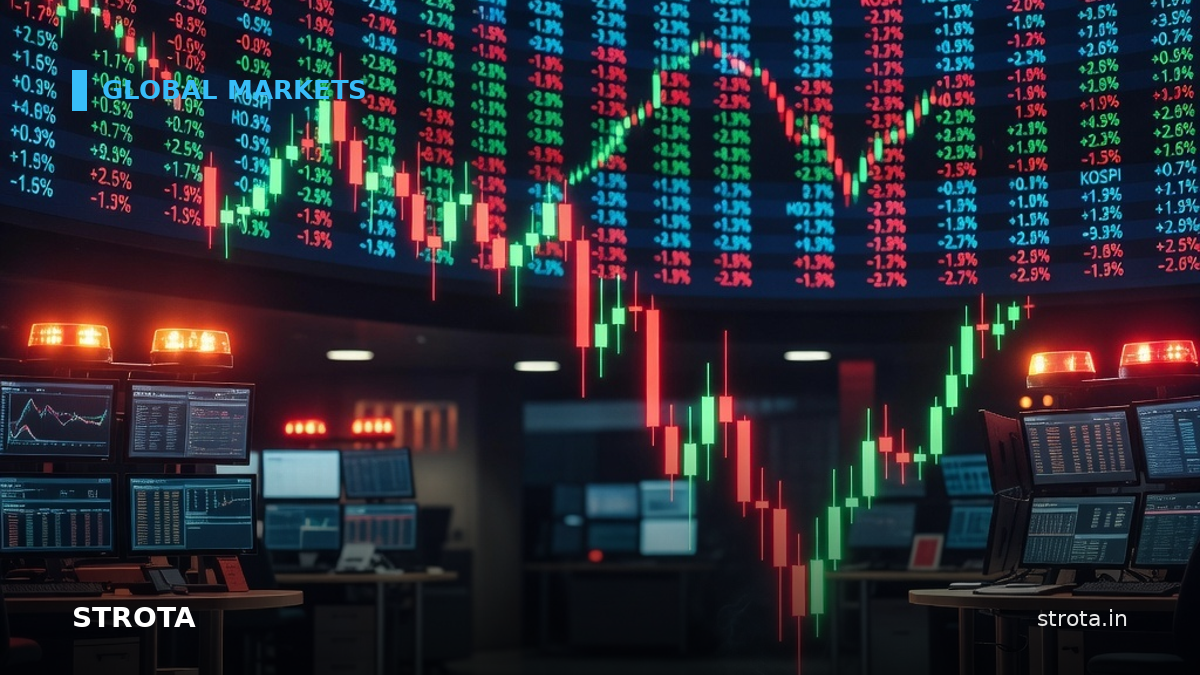
The warning flashed first in Seoul. Before American traders had finished their morning coffee, Samsung Electronics and SK Hynix—South Korea's twin semiconductor giants—were already in freefall. Shares of both companies tumbled more than 9% as the KOSPI index cratered 10%, triggering a cascade that would soon slam Wall Street. By the time U.S. markets opened, the Nasdaq had crashed 2%, chip stocks were in their worst week in more than a year, and investors were scrambling to understand how a market many once considered peripheral had become the world's most sensitive AI barometer.
This is the new geography of global risk. Korea's $4 trillion equity market, long treated as a satellite of larger economies, has quietly transformed into something more consequential: an early-warning system for the entire artificial-intelligence trade. When sentiment shifts around AI spending and chip demand, it now shows up first in the concentrated, AI-heavy Korean bourse—then ripples outward through Taiwan's TSMC, Japan's SoftBank, and finally into the Magnificent Seven stocks that dominate U.S. indices.
The mechanics are straightforward but brutal. Samsung and SK Hynix together represent a massive weight in Korean markets, and both are deeply embedded in the global AI supply chain—manufacturing the high-bandwidth memory that powers the data centers driving the ChatGPT era. When investors grow nervous about whether AI infrastructure spending can sustain its breakneck pace, these two companies absorb the first blows. Their pain then transmits instantly to Wall Street through the dense web of global chip indices, futures contracts, and cross-border fund flows that knit modern markets together.
The recent selloff followed a familiar pattern. China's Moonshot AI had unveiled another breakthrough, adding fresh fuel to Wall Street's anxiety about whether American technological dominance—and the massive capital expenditures supporting it—could be sustained. The fear is not that AI will fail, but that it might evolve differently or more cheaply than expected, rendering billions in planned chip factories and data centers less profitable than projected. This uncertainty hit Korean markets first, then washed ashore in New York.
What unfolded next illustrated the feedback loops that now define global investing. As Korean shares plunged, U.S. chip stocks followed: Micron, AMD, and Nvidia all dropped as much as 7%. The Nasdaq Composite fell 1.5% in a single session. The VIX, Wall Street's fear gauge, surged 12%. Even the staid Dow Jones Industrial Average, buffered by healthcare giants like UnitedHealth, couldn't fully escape the downdraft. For a second straight day, chip stocks led markets lower, with Alphabet's earnings disappointment adding extra drag.
The episode exposed a vulnerability that many portfolio managers are only now fully appreciating. The same AI concentration that delivered record Wall Street profits—Goldman Sachs and other major banks just posted their best quarters ever, partly on AI-driven trading and deal flow—has also created new channels for contagion. When South Korea's central bank governor speaks, or when Seoul releases chip export data, sophisticated investors now listen as intently as they do to Federal Reserve officials.
This shift carries practical consequences for how markets move. Analysts tracking the Sensex in Mumbai or the FTSE in London now monitor Korean overnight action for clues about the coming session. The correlation is not perfect—local factors still matter, as when India's benchmark surged 960 points on domestic earnings optimism—but the Korean signal has become increasingly hard to ignore. When Seoul's market moves sharply, probability tables for the next day's U.S. trading get rewritten.
For ordinary investors, the lesson is about interconnectedness rather than any specific trading strategy. The portfolio in your retirement account—perhaps heavy on S&P 500 index funds—now contains indirect exposure to decisions made in Korean corporate boardrooms and Chinese AI labs. The semiconductor supply chain, with its concentrated geography and astronomical capital requirements, has created chokepoints where local turbulence generates global storms.
The irony is that this vulnerability emerged from success. Korea's deliberate industrial policy, decades in the making, built world-beating memory chip manufacturers that now sit at the center of the AI revolution. Wall Street's enthusiasm for that revolution, expressed through soaring valuations for Nvidia and its peers, tied Korean fortunes to American portfolios more tightly than ever before. The result is a market structure where a 10% move in Seoul can erase hundreds of billions in U.S. market value before lunch.
Whether this sensitivity persists depends on how the AI investment cycle evolves. If spending on data centers and specialized chips continues its exponential growth, Korean stocks may resume their role as leading indicators of strength rather than weakness. If doubts about AI returns deepen, the same mechanism will transmit fear just as efficiently. Either way, the era of Korea as a peripheral market has ended. For global investors, the new reality is that some of the most important trading now happens while New York sleeps.
The chip selloff that rattled markets worldwide this past week was not fundamentally about Korea, or even about chips. It was about whether the story investors have told themselves—that artificial intelligence will transform the economy quickly enough to justify massive upfront investment—still holds. That story is now tested first in the most leveraged, most concentrated market on earth. When you want to know which way the AI wind is blowing, check Seoul before you check Silicon Valley.
Sources and method
- Move Over Wall Street: How Korea's AI-Heavy Market Became The Global Stock Bellwether (NDTV Business)
- Ahead of Market: 10 things that will decide D-Street action on Monday (Economic Times)
- Small Business Technology News Roundup: IBM Shares Crash, ChatGPT To Replace Wall Street Analysts (Forbes)
- Asia AI bets power record equities run for Wall Street banks (Financial Times)
- China’s Moonshot AI Adds More Fuel to Wall Street’s Chip Selloff (WSJ)
- US Stock Market Today: S&P 500 Sinks; Nasdaq Crashes 2% As Chip Stocks Selloff Worsens (NDTV Profit)
- Wall St ends lower for the day and week as chip selloff broadens (Reuters)
- Stock market today: Stocks fall after Netflix whiff while with chip stocks sell-off hammers Nasdaq (Yahoo Finance)
More money stories
- Thirteen Nifty stocks dragged the index for five years — and active funds noticed
- Copper at a record $14,533 a ton, and a new rival: the double squeeze on India's cable makers
- Asian Markets Slip as AI Stocks Weigh Ahead of Nvidia's Earnings Test
- IPO subscription tracked listing gains across 431 Indian IPOs, but it works as a sorter, not a direction call
- New moon, full moon, same Nifty: 19 years of data show no reliable lunar effect
- RBI opens a dollar window for 3 oil firms as the rupee nears 97