The $114 Billion Shadow Economy: How a Simple Phone Handover in Bali Can Empty Your Life Savings
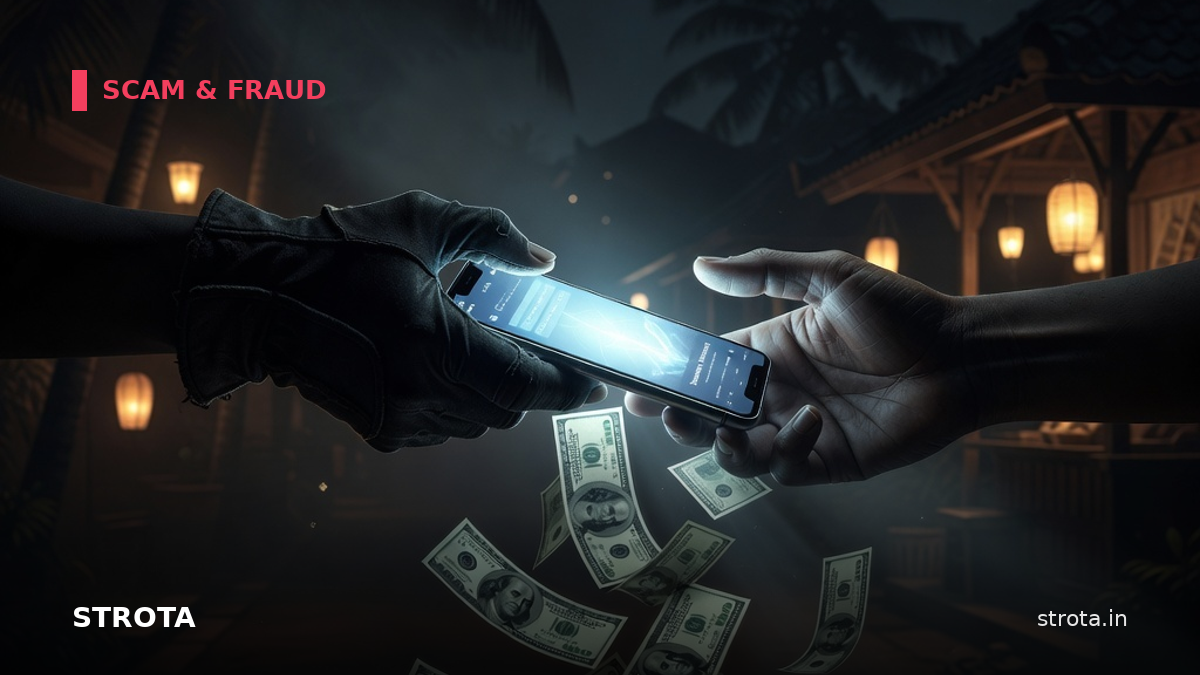
The vacation photo looked innocent enough. A traveler in Bali, phone unlocked, passing it to a friendly local woman to help with directions. Hours later, ₹13,50,000 had vanished from their accounts. The incident, reported by NDTV Business, is not an outlier—it is a textbook opening move in what has become the world's fastest-growing criminal enterprise.
Social engineering, the psychological manipulation of victims, has replaced brute-force theft. Scammers exploit the universal human instinct to trust, to help, to believe that a verified-looking news article or a well-dressed courier at the door represents legitimacy. The Bali case illustrates how low-tech the entry point can be. No malware. No hacking. Just an unlocked screen and a moment of inattention.
What happens next is anything but low-tech.
The United Nations estimates that Asia-Pacific cyberscam networks alone extracted up to $114 billion from victims in a single year. That figure, which rose to $147 billion the following year, exceeds the annual economic output of most countries. These are not isolated con artists. Police in Pasig, Philippines, recently arrested 63 suspects in a single hub. A separate operation in Africa netted 651 arrests and recovered $4.3 million. One dismantled European network was generating €100 million monthly.
The industrial scale becomes clearer when you examine the specialization. In Albania, operators target French speakers. In Sydney, an Israeli money launderer was convicted for processing proceeds. Dutch police traced €25 million in fake investments to a single criminal network. The FBI now warns of couriers physically collecting cash from victims' homes—a retro touch that bypasses digital forensics.
Artificial intelligence has accelerated everything. A 76-year-old lost $1.6 million to an AI investment scam. Australian authorities report millions lost to AI-powered schemes in 2026 alone. Fraudsters now generate fake video news segments—what one victim called 'a very good clone'—featuring synthetic anchors promoting fraudulent platforms. The technology that lets teenagers create deepfake memes now enables the systematic destruction of retirement funds.
The demographics defy easy assumptions. Seniors lose hundreds of millions annually, yet Hong Kong data reveals a paradox: elderly victims who knew finance actually lost more on average—HK$850,000—perhaps because overconfidence made them slower to recognize manipulation. In the UK, investment fraud losses reached £220 million in one year, or £1,675 every minute. British courts have jailed fraudsters for £11 million and £11.5 million schemes specifically targeting 'older and vulnerable' victims.
Cryptocurrency has become both weapon and obstacle. U.S. prosecutors moved to seize $25 million in crypto tied to romance and investment scams. Circle, a major stablecoin issuer, reportedly rebuffed police efforts to assist victims—illustrating how decentralized finance's design can frustrate traditional recovery mechanisms. The FBI now warns of scammers sending couriers to collect physical cash precisely because crypto tracing has improved.
The aftermath extends beyond financial loss. Victims face 'crippling tax bills' on stolen money—money they never truly possessed—because current IRS rules treat scam proceeds as taxable income until proven otherwise. A bill in Congress aims to waive these penalties, recognizing that the trauma compounds when government agencies demand payment on phantom gains. One adviser described a client who lost life savings to a romance scammer, then received a tax demand.
Institutional responses remain patchwork. JPMorgan and Bank of America face accusations from victims who believe banks should have flagged suspicious transactions. Meta appears likely to avoid liability for WhatsApp investment scams. Australian regulators propose rapid $3,000 refunds for victims, while UK mechanisms reportedly average closer to $160,000 in compensation—suggesting vast disparities in how societies absorb these losses.
The human cost surfaces in fragments. 'Sick to my stomach,' said one victim of a $1.8 million scheme. Martin Lewis, the UK consumer champion whose image is constantly stolen for fake endorsements, admits defeat: 'Am I losing this battle? Yes.' The question haunts anyone who has watched a parent, neighbor, or colleague fall into the trap.
What emerges from the data is a fundamental asymmetry. Scammers require only moments of inattention—a shared phone, a clicked link, a responded-to message. Recovery requires months of legal proceedings, tax disputes, and psychological rebuilding. The $114 billion figure represents not just stolen money but stolen time, trust, and the capacity to feel secure in ordinary transactions.
For the traveler in Bali, the lesson arrived too late. For everyone else, it is a reminder that in an economy of engineered attention, vigilance is not paranoia but a necessary survival skill. The woman who borrowed the phone was not asking for help. She was conducting intake for an industrial operation that spans continents, employs hundreds in single locations, and improves its methods faster than institutions can adapt.
Sources and method
- Bali Crypto Scam? Tourist Loses Rs 13,50,000 After Sharing Unlocked Phone To Woman, Claim Goes Viral (NDTV Business)
- Victims Claim JPMorgan, Bank of America Should Have Caught Signs of $328M Crypto Scam (Yahoo Finance)
- Crypto giant Circle rebuffed efforts to help scam victims, police say (International Consortium of Investigative Journalists - ICIJ)
- Crypto scammers prey on French victims from Albania (France 24)
- Crypto investment scam sends couriers to collect victims' cash, FBI warns (Bitdefender)
- U.S. Prosecutors Move To Seize $25 Million In Crypto From Romance And Investment Scams (Bitcoin World)
- Man arrested for providing bank account for investment scam in Gurugram (ThePrint)
- 76-year-old loses $1.6 million savings to AI investment scam (NBC News)
More money stories
- A 12.3 billion won crypto scam, a group in custody, and a news line that leaves the rest blank
- A counterfeit crypto site, a fraud ring earning €100 million a month, and an arrest in Arunachal
- The $114 Billion Shadow: How AI Turned the Oldest Con Into an Industrial Machine
- The $25 Million Crypto Seizure That Exposes How Scammers Turn Lonely Hearts Into Empty Wallets
- CBI books Subhash Chandra over an alleged ₹1,322-crore loss to LIC Housing Finance
- Goldman Sachs and BNP Paribas bought ₹1,041 crore of Swiggy in a single session