The Trader Who Watched Gold and Oil Dance in Opposite Directions — on the Same News
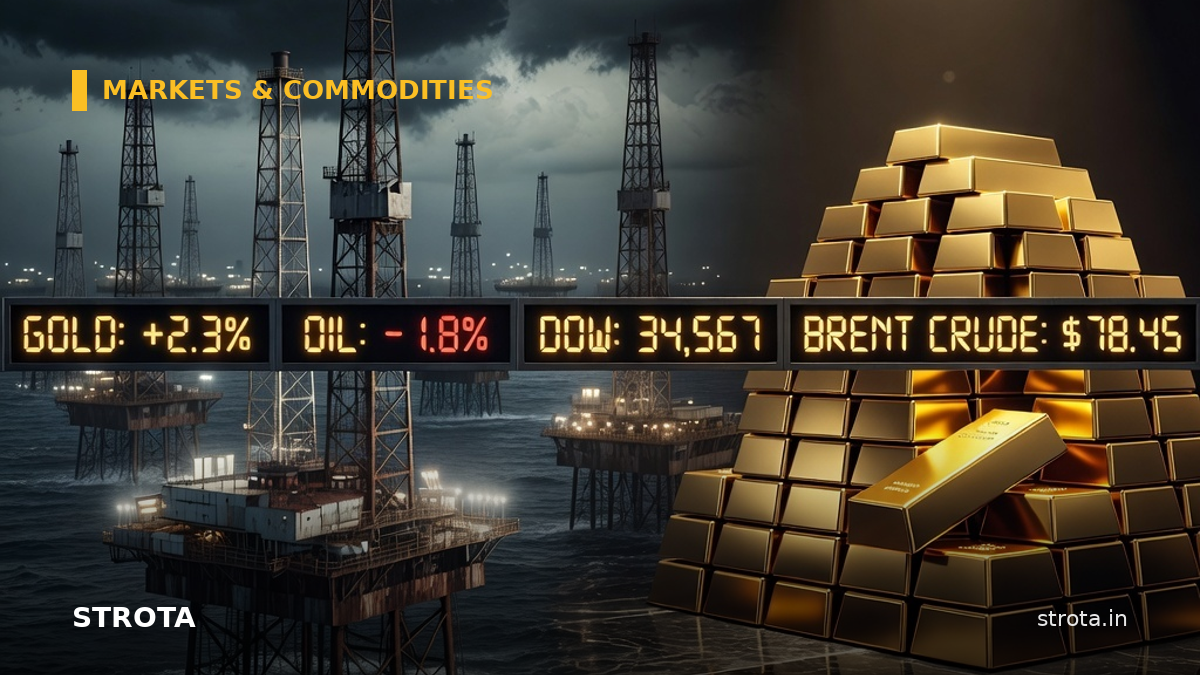
Tuesday morning, somewhere between Mumbai and Singapore, a commodities trader refreshed two screens at once and saw something that made no immediate sense. Oil was up nearly 2%. Gold was up too. Then, within hours, oil slipped back below $90 while gold kept climbing. The same headlines had pushed both markets — just in different directions, at different speeds.
The trigger was familiar: fresh attacks between the United States and Iran, with Yemen's Houthis threatening to blockade Saudi Arabia by sea. An unknown projectile struck a tanker in the Strait of Hormuz, that narrow chokepoint through which a fifth of the world's oil flows. President Donald Trump had already warned that Iran would 'pay' for the deaths of three US service members. The machinery of escalation was grinding forward.
Yet something else was happening in parallel. Mediators had begun floating ceasefire proposals. Iran, according to reports, was actually considering them. This is the peculiar physics of commodity markets in wartime — every headline carries its own shadow, and traders must guess which one will land heavier.
The numbers tell the story of this uncertainty. MCX gold August futures climbed 0.57% to Rs 1,42,150 per 10 grams, extending gains for a second straight session. Silver surged 1.04% to Rs 2,20,668 per kg. Physical gold in India jumped Rs 1,000 per 10 grams; silver added Rs 3,100 per kilogram. These are not panic numbers. They are the measured, persistent buying of people who have learned that diplomatic hope rarely arrives without violence first.
Oil, meanwhile, performed its own nervous dance. Brent crude futures slipped 35 cents to $88.87 a barrel. US West Texas Intermediate crude for September delivery barely moved, settling at $82.47. Both remained below the one-month highs touched just a day earlier. The rally had been real — Monday's surge came on Trump's threats and the Houthi embargo announcement — but it proved fragile. When markets sniff even the possibility of talks, they punish oil's war premium.
This divergence matters beyond trading floors. In India, where fuel prices ripple through everything from vegetable delivery to factory shifts, the bond market felt immediate pressure when crude pushed past $90. Indian bonds came under strain. SK Eternix, a company tied to energy infrastructure, jumped 9% intraday on the oil spike. These are not abstract connections. They are the transmission lines between a tanker strike in the Gulf and a family's monthly budget in Bangalore.
The Houthi threat deserves particular attention. A naval blockade on Saudi Arabia would not merely disrupt oil flows; it would force rerouting around the Cape of Good Hope, adding weeks and costs to every shipment. The Houthis have demonstrated their reach before, targeting vessels with drones and missiles. Their announcement of a 'maritime embargo' — diplomatic language for piracy with a political license — kept oil's floor firm even as the ceiling softened on talk of ceasefires.
Russia's gold reserves, mentioned almost in passing in the flow of reports, offer a quieter footnote. They have seen slight decreases this year. Moscow has been among the most aggressive sovereign gold accumulators of the past decade, so any diminishment suggests either funding pressures or a strategic shift in how it manages its war economy. Gold remains the asset of last resort, but even last resorts sometimes get spent.
What emerges from this tangle is not a clear direction but a condition: sustained uncertainty. Gold's rise reflects the recognition that diplomatic contacts, however active, do not resolve overnight what years of hostility have built. Oil's partial retreat reflects the equally valid recognition that markets price what they can see, and a potential ceasefire is visible in ways that a potential blockade is not.
For anyone watching these markets from outside — the worker whose commute cost fluctuates, the family considering gold for a daughter's wedding, the retiree with a small commodities fund — the lesson is uncomfortable. The same event can be bullish and bearish simultaneously. The same headline can send your fuel bill up and your gold holdings up too, not because the world makes sense but because different markets are asking different questions of the same facts.
The trader with two screens eventually makes a decision, or doesn't. The rest of us simply live with the consequences of those decisions, aggregated across millions of transactions, until the next headline arrives and the dance begins again.
Sources and method
- Crude oil prices rise 2% on fresh attacks by US and Iran (Economic Times)
- Gold prices rise by Rs 1,000/10g, silver up Rs 3,100/kg on hopes of Iran peace talks. Key levels to watch today (Economic Times)
- Gold Price Today: MCX Gold Jumps To Rs 1.42 Lakh As US-Iran Uncertainties Continue (NDTV Business)
- Gold gains as hopes for US-Iran diplomacy cool oil price rally (Economic Times)
- Oil Price Today (July 21): Crude oil dips below $90 on hopes of 10-day ceasefire in Iran war. What are experts saying? (Economic Times)
- Petrol, Diesel Prices On July 21: Check New Fuel Rates In Mumbai, Bengaluru, Chennai, Kolkata And More (NDTV Business)
- Indian bonds come under pressure as crude prices surge over $90 a barrel (The Hindu)
- Gold Price Forecast: Gold Rebounds From $4,000 Amid Market Uncertainty (FXEmpire)
More money stories
- Bitcoin ETFs took in $999 million in a day as the price cleared $87,000
- Five straight weekly losses for Indian government bonds, and the reason starts in Washington
- A Fed Hike, a Rupee Near 96 and Why the RBI October Call Just Got Hard
- One oil shock, two opposite answers: Tokyo hikes to a 31-year high, London sits still
- Brent hit $107.05 after a Saudi pipeline went down, and Goldman Sachs sketched a $120 scenario
- Iran's claim on 10 ships took crude to $101, and put one hundred twenty dollars back in the conversation