The Weekend Oil Spiked 10%: How a Single Strait Became Everyone's Problem
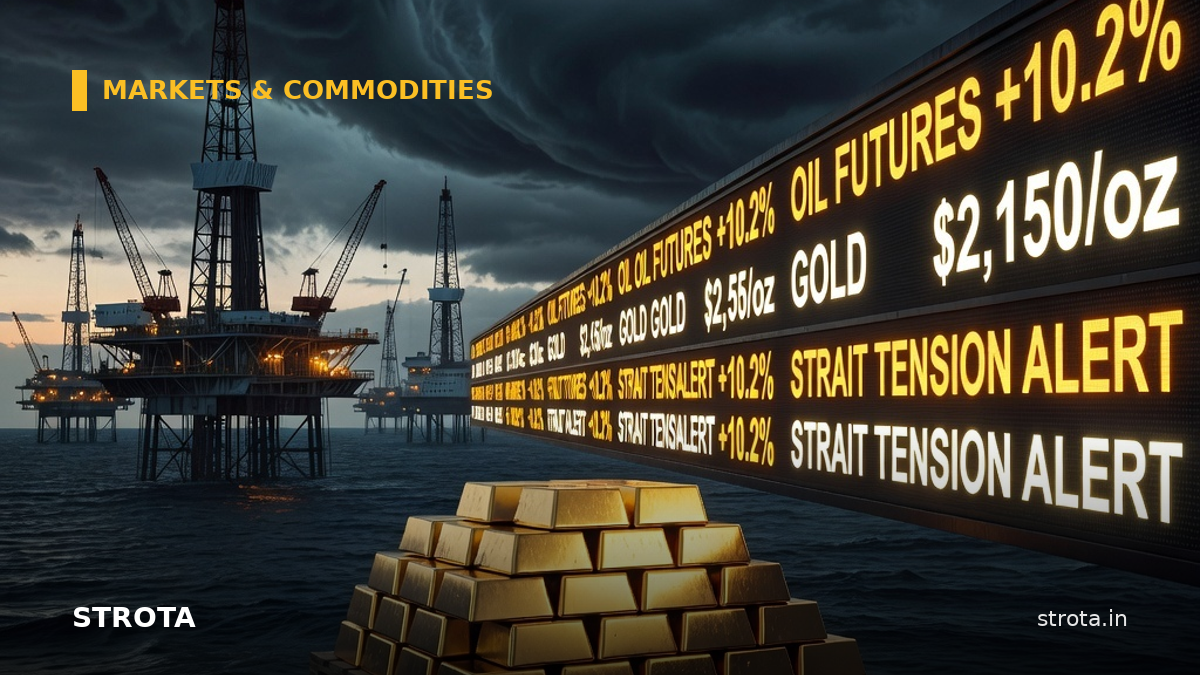
Imagine checking your phone on a Friday morning to find that filling your tank next week might cost significantly more—not because of anything you did, but because of naval movements halfway around the world. That's precisely what happened when oil prices climbed to their highest point in over a month, with some grades surging nearly 10% in a matter of days.
The immediate trigger was unmistakable: renewed hostilities between the United States and Iran. Attacks intensified across the Gulf region, and suddenly one of the world's most critical chokepoints for global energy—the Strait of Hormuz—looked vulnerable. Roughly one-fifth of global petroleum consumption passes through that narrow waterway. When it sneezes, the world's fuel supply catches a cold.
Saudi Arabia didn't wait to see what happened next. The kingdom redirected significant crude exports to avoid the Strait entirely, a costly but prudent insurance policy. Think of it as a major highway closing and every trucker simultaneously hunting for back roads—except these trucks carry millions of barrels of oil, and the detour adds days to every journey.
The market absorbed this risk instantly. Crude pushed toward $90 per barrel, and the consequences multiplied in unexpected directions. United Airlines warned of a $6 billion hit on fuel costs—roughly equivalent to the entire annual profit of some major carriers. For an ordinary traveler, that translates to fewer cheap seats and more crowded planes.
Meanwhile, gold and silver investors found themselves in a confusing bind. Precious metals often rise during geopolitical chaos, but this time they stumbled. Gold fell below $4,000 per ounce in some markets, and Indian gold rates dropped near ₹1.47 lakh per 10 grams. Why? Because oil-driven inflation fears made traders bet that central banks would keep interest rates higher for longer—and gold hates high rates.
The contradictions piled up. Gold had surged earlier on cooling US inflation data, only to retreat when oil's spike revived inflation anxiety. Silver crashed ₹6,000 per kilogram in Indian markets even as physical silver deficits hit record levels. Markets, it seems, can hold two opposing fears simultaneously.
Beyond trading screens, the pressure mounted on household budgets and government ledgers alike. One Indian analysis projected that sustained oil prices could add up to ₹70,000 crore to the country's fertilizer subsidy bill in the coming fiscal year. Farmers' input costs, food prices, and ultimately what families pay for dinner—all connected to distant tanker routes.
Some saw opportunity in the disruption. Electric vehicle sales accelerated as high oil prices made the math of switching more compelling for drivers on the fence. Formosa Petrochemical's stock broke NT$70 in Taiwan, hitting a two-year high as regional refiners anticipated strong margins. Big Oil headed for record profits. Crisis, as always, redistributed wealth dramatically.
Then came the policy whiplash. Reports emerged of an extended US maritime blockade on Iranian ports scheduled to resume, followed by President Trump's declaration that the Iran ceasefire was 'over.' Oil prices had already surged 18% in some measures from their recent lows. Each headline sent fresh tremors through futures markets.
Amid this volatility, one quieter development offered perspective. The United Arab Emirates, no longer constrained by OPEC production quotas after its exit, pushed oil output toward record highs. More supply, eventually, could soften prices—if geopolitics permits it to reach market.
For most people, this story isn't about trading crude futures or timing gold purchases. It's about the invisible infrastructure that shapes daily life: the strait most couldn't locate on a map, the shipping route never contemplated until it threatens to close, the sudden realization that a distant conflict can reach into a paycheck or a grocery bill within weeks. The world's energy system remains stubbornly, precariously interconnected—and when friction enters the system, everyone pays the toll.
Sources and method
- Oil settles up on renewed US-Iran hostilities and threat of Red Sea closure (Economic Times)
- Oil prices surge as renewed US and Iran tensions fuel supply fears (businessreport.co.za)
- Oil prices surge toward $90 as US-Iran tensions and Strait of Hormuz risks escalate. (Pluang)
- Oil prices jump as US-Iran conflict escalates again (The Hill)
- Fuel rationing, petrol price spike fears, as Iran war leads to oil market surge (ABC News & Headlines – Australian Broadcasting Corporation)
- US-Iran Update: Oil Prices Surge By 4% as Iran Escalates Fresh Attacks on Gulf Allies (CoinGape)
- What Trump’s New Iran Blockade Could Mean for Oil Prices (The New York Times)
- United warns of $6 bln hit on fuel costs amid oil-price surge (Reuters)
More money stories
- Bitcoin ETFs took in $999 million in a day as the price cleared $87,000
- Five straight weekly losses for Indian government bonds, and the reason starts in Washington
- A Fed Hike, a Rupee Near 96 and Why the RBI October Call Just Got Hard
- One oil shock, two opposite answers: Tokyo hikes to a 31-year high, London sits still
- Brent hit $107.05 after a Saudi pipeline went down, and Goldman Sachs sketched a $120 scenario
- Iran's claim on 10 ships took crude to $101, and put one hundred twenty dollars back in the conversation