When Oil Spikes 12% in a Week, Gold Stumbles—And Your Wallet Feels Both
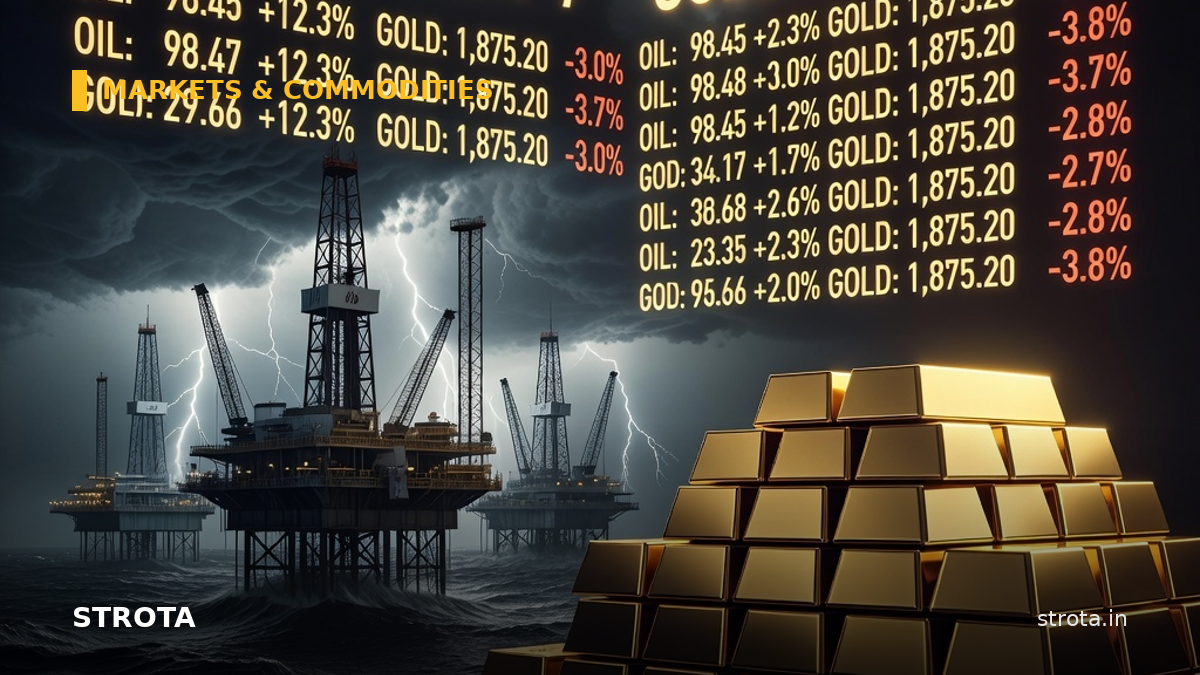
Picture this: You're filling up your tank on a quiet Friday evening, wincing at the numbers climbing on the pump. Then your phone buzzes with news of explosions in the Persian Gulf. By Monday, the same fill-up costs 12% more—and your retirement portfolio just took a hit from two directions at once.
That's the lived reality unfolding this week as crude oil benchmarks have staged their sharpest rally in months. Brent crude futures climbed to $85.28 a barrel, while U.S. West Texas Intermediate touched $79.98—both recovering from earlier losses to post weekly gains of nearly 12%. Brent is now headed for its third straight weekly advance; WTI for its second.
The catalyst is depressingly familiar: escalating conflict between the United States and Iran, with fresh strikes and renewed threats to the Strait of Hormuz, the narrow waterway through which roughly one-fifth of global oil shipments pass. When those supply routes wobble, every economy on Earth holds its breath.
But here's where this story takes an unexpected turn. While oil surges, gold—the traditional refuge when missiles fly—has actually slipped. MCX gold August futures dipped 0.42% to Rs 1,41,207 per 10 grams, while silver futures dropped 0.4%. The safe haven, it seems, has developed a leak.
The explanation lies in a second, quieter shockwave. Traders have begun boosting bets that the Bank of England and European Central Bank will raise interest rates, responding to oil-driven inflation pressures. Higher rate expectations strengthen the dollar and raise the opportunity cost of holding non-yielding gold. The yellow metal, caught between its geopolitical appeal and its interest-rate arithmetic, is losing the tug-of-war.
For ordinary households, this double movement creates a peculiar squeeze. Your transportation costs rise immediately with fuel prices. Your grocery bill follows—fertilizer subsidies in India alone could swell by Rs 70,000 crore in the coming fiscal year, with ripple effects on food prices. Yet your traditional inflation hedge, that gold jewelry or ETF tucked away for rainy days, isn't performing its usual protective function.
The Indian rupee, meanwhile, has settled near record lows around 96.30 against the dollar, squeezed between surging import costs and capital flight toward safer assets. Domestic stock markets have whipsawed—opening cautiously higher some sessions, then plunging 561 points on the Sensex as the reality of sustained higher oil prices sank in.
Even corporate giants are recalibrating. United Airlines has warned of a nearly $6 billion fuel cost hit, a figure that will eventually appear in ticket prices. BP has managed to cut net debt thanks to the price surge—a reminder that for every household squeezed, there's an oil major booking record profits.
The longer-term implications are already surfacing in unexpected places. Analysts note that the 2027 Social Security cost-of-living adjustment could be boosted by this oil-price spike—small comfort for retirees today, but a sign of how deeply energy costs embed themselves in institutional calculations. Electric vehicle sales are accelerating as drivers reconsider their relationship with fossil fuels.
What's striking about this moment is how quickly the narrative can reverse. Some headlines from recent weeks show crude crashing 5% on peace-deal rumors, or international prices hitting three-year lows. The market is pricing not current reality but the terrifying possibility of Hormuz closure—a supply shock that traders are already bracing could push prices toward $100.
For most of us, there's no actionable trade here. You cannot hedge your commute. You cannot arbitrage your heating bill. What you can recognize is the interconnected fragility of a system where one strait, one conflict, one week's worth of headlines can simultaneously raise your costs, weaken your currency, and scramble the traditional rules of where to hide.
The gold-versus-oil divergence this week is more than a market curiosity. It's a signal that the old playbooks are fraying—that inflation protection and geopolitical risk no longer move in lockstep, and that the next crisis may not look like the last one. When the safe haven sinks while danger rises, the only certainty is that ordinary savers will need to think harder about what they're actually protecting against.
Sources and method
- Oil Price Today (July 17): Crude oil jumps 12% this week as Hormuz, Red Sea closure risks loom. What are experts saying? (Economic Times)
- Gold Price Today: MCX Gold Slips To Rs 1.41 Lakh After Fresh US Strikes On Iran (NDTV Business)
- Why Is Gold Price Falling Today? (Sahi)
- MCX Crude Oil prices continue to surge amid rise in US-Iran conflict; check today’s trade setup (Upstox)
- Indian Markets Open Cautiously In Green Amid Oil Price Rise, Escalation Of Supply Disruptions Risk From Iran (Open Magazine)
- Oil surges as US strikes Iran, reversing return to pre-war prices (Al Jazeera)
- Oil Prices Jump 9% After Back-and-Forth Strikes by U.S. and Iran (The New York Times)
- Oil climbs to one-month high as US, Iran step up attacks in Strait of Hormuz (ET EnergyWorld)
More money stories
- Bitcoin ETFs took in $999 million in a day as the price cleared $87,000
- Five straight weekly losses for Indian government bonds, and the reason starts in Washington
- A Fed Hike, a Rupee Near 96 and Why the RBI October Call Just Got Hard
- One oil shock, two opposite answers: Tokyo hikes to a 31-year high, London sits still
- Brent hit $107.05 after a Saudi pipeline went down, and Goldman Sachs sketched a $120 scenario
- Iran's claim on 10 ships took crude to $101, and put one hundred twenty dollars back in the conversation