When Oil Spikes and Gold Follows: How One Family's ₹1.42 Lakh Bet Mirrors India's Nervous Moment
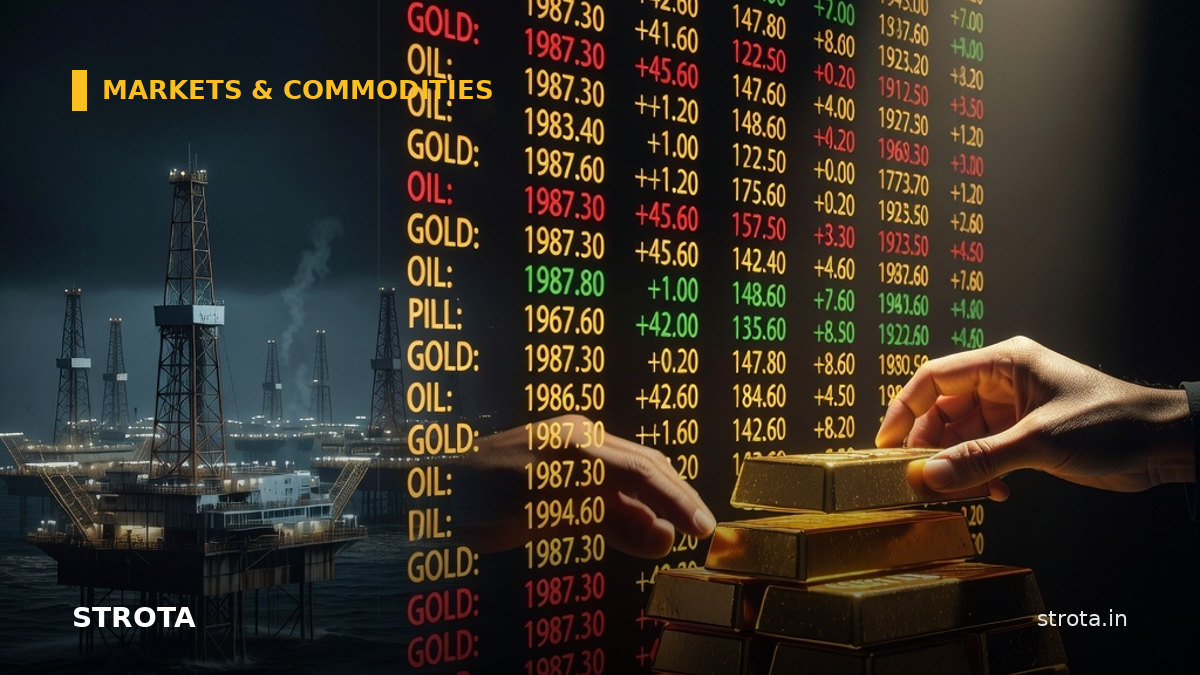
Somewhere in Hyderabad, a middle-aged investor stared at her phone last Tuesday and felt her stomach drop. The gold bangles she'd postponed buying for her daughter's wedding? They'd jumped another ₹1,040 in a single day. Ten grams now demanded ₹1,42,150 on the MCX — roughly ₹10,000 pricier than January. The August futures contract had climbed 0.57% overnight, part of a relentless march that has turned every postponed purchase into a small tragedy.
She wasn't alone in her vertigo. Across India, families and fund managers are discovering an uncomfortable truth: the traditional safe haven is becoming dangerously expensive to reach.
The immediate culprit sits 2,000 kilometers west, where the mathematics of fear is being rewritten daily. Yemen's Houthis have threatened a naval blockade that could choke oil shipping routes. Brent crude, after touching one-month highs above $90, slipped modestly to $88.87 — but the relief feels temporary. U.S. West Texas Intermediate crude hugged $82.47, barely changed, as if holding its breath. Mediators shuttle proposals to Tehran, yet the diplomatic whispers compete with louder noises: Trump's declaration that Iran will 'pay' for American deaths, the back-and-forth strikes across the Gulf, the 9% single-day oil jump that followed earlier escalations.
This is not how the safety trade is supposed to work.
Conventionally, gold glitters when oil spikes — inflation fears, dollar weakness, the whole familiar dance. But 2026 has scrambled the choreography. Gold's surge to ₹1,42,150 arrives even as oil's volatility creates what traders call 'cross-asset tension.' The MCX silver September futures, up 1.04% to ₹2,20,668 per kilogram, tell the same story: precious metals are rising not from confidence but from exhausted alternatives.
The mechanics reveal India's particular vulnerability. The country spent $14.7 billion on crude imports in June alone, a 60% surge in April-June purchases as refiners scrambled ahead of anticipated disruptions. Net oil and gas imports jumped 45%. Each dollar on Brent exerts gravitational pull on the rupee, which neared record lows until RBI intervention steadied the currency. For a nation importing 85% of its fuel, gold's rally carries a bitter aftertaste: we're paying more for safety because our other bills are becoming unbearable.
The global picture sharpens the irony. Central banks worldwide hoarded gold at record pace even as oil spikes capped traditional safe-haven gains. Russia's gold reserves slipped slightly this year — a rare admission that even bullion stockpiles face pressure. In China, June Gulf crude imports plunged as higher prices met slumping demand, a warning of demand destruction that could eventually crater the very oil rally feeding gold's rise.
For Indian investors, the dilemma is excruciatingly specific. Gold has gained roughly 2% in dollar terms recently, touching $4,080 per ounce before retreating. But rupee depreciation amplifies every move. The Hyderabad investor's postponed bangles aren't merely more expensive — they're escaping faster than her savings can compound.
Corporate India feels parallel pressures. United Airlines warned of nearly $6 billion in additional fuel costs. Airlines, logistics firms, any business with diesel in its veins faces margin compression that gold ownership cannot hedge. The inflation print of 4.1% — itself a product of energy costs — keeps Federal Reserve hawkishness alive, which strengthens the dollar, which pressures emerging market currencies, which makes imported gold costlier in rupee terms. The feedback loop is merciless.
Yet the most telling detail may be the quietest. Asian stocks, after recent chip-driven losses, showed tentative recovery as megacap technology earnings approached. Investors crave corporate results and de-escalation alike. But oil above $90 — or the threatened $120 some analysts project if Red Sea blockades materialize — could abort any rebound. Gold at ₹1,42,150 represents not optimism but the price of having nowhere else to hide.
The Hyderabad investor made her decision Wednesday morning. She bought half the required gold, accepting the premium, and converted the remainder to a sovereign gold bond — government-backed, interest-bearing, denominated in grams rather than jewelry. It wasn't the wedding gift she'd imagined. It was what the moment allowed.
For millions of Indians, this is the new arithmetic of security: partial solutions, inflated prices, and the persistent suspicion that safety itself has become a luxury good. The MCX numbers will fluctuate. The Strait of Hormuz may open or close. But the lesson of ₹1,42,150 gold is more durable — in uncertain times, the cost of sleeping soundly keeps rising, and not everyone can afford the rest they need.
Sources and method
- gold price (Google Trends)
- Google Trends
- Google Trends
- Google Trends
- Gold Price Today: MCX Gold Jumps To Rs 1.42 Lakh As US-Iran Uncertainties Continue (NDTV Business)
- Gold gains as hopes for US-Iran diplomacy cool oil price rally (Economic Times)
- Oil Price Today (July 21): Crude oil dips below $90 on hopes of 10-day ceasefire in Iran war. What are experts saying? (Economic Times)
- Global Market Today: Asian stocks recover as chips rebound, oil dips (Economic Times)
More money stories
- Bitcoin ETFs took in $999 million in a day as the price cleared $87,000
- Five straight weekly losses for Indian government bonds, and the reason starts in Washington
- A Fed Hike, a Rupee Near 96 and Why the RBI October Call Just Got Hard
- One oil shock, two opposite answers: Tokyo hikes to a 31-year high, London sits still
- Brent hit $107.05 after a Saudi pipeline went down, and Goldman Sachs sketched a $120 scenario
- Iran's claim on 10 ships took crude to $101, and put one hundred twenty dollars back in the conversation