The £1,675-Minute: How Investment Scams Became the Fastest-Growing Theft in Your Pocket
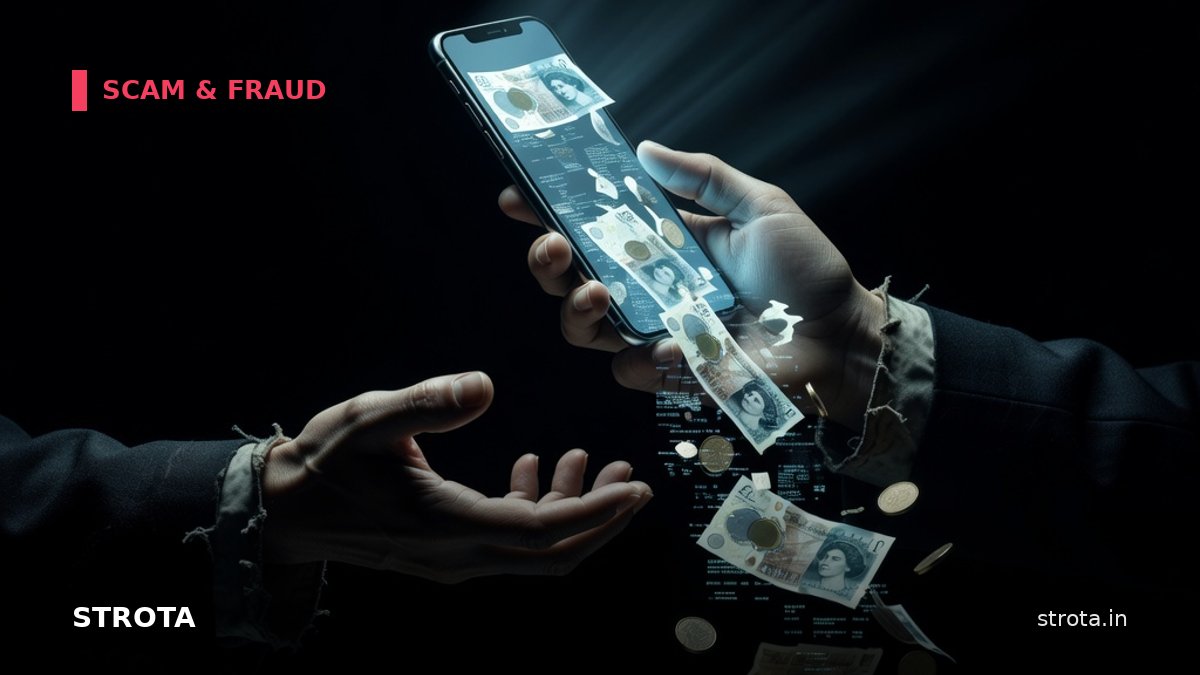
Imagine watching £1,675 vanish from your account every sixty seconds. That is not a market crash. That is not a bad trade. That is the measured, industrial pace at which investment fraud consumed British victims in 2025, according to City of London Police — £2.4 million each day, gone to strangers who never touched a vault or fired a weapon.
The machinery of this theft is everywhere now. In Tamil Nadu, a woman lost Rs 10.57 lakh to a young man in Assam who promised cryptocurrency riches. In Tokyo, a Taiwanese operator extracted nearly ¥100 million. A Bradenton man in Florida handed $100,000 to a North Carolina woman who seemed trustworthy. The geography collapses. The method remains identical: promise, pressure, then disappearance.
What makes this moment different is the sophistication. Scammers no longer rely on clumsy emails. They build fake news sites — 'a very good clone,' as one investigator described them — complete with fabricated headlines and celebrity endorsements. They deploy AI to craft voices and faces that convince victims they are video-chatting with a financial advisor. They operate from call centers employing 700 people, as Dutch police discovered in one network alone, generating €100 million monthly before authorities dismantled it.
The human entry points have multiplied. Romance and investment have merged into 'pig butchering' scams, where a stranger cultivates intimacy for weeks before introducing an 'exclusive' trading platform. Matrimonial sites have become hunting grounds — three men in Kerala used one to cheat a doctor of Rs 37 lakh. Even faith communities are targeted: an Arlington man faces indictment over a $3.2 million scheme built around church connections.
The amounts are no longer petty. A single operation in Spain netted €140 million. German courts convicted a mastermind behind a global network. Dutch and Europol investigators traced €600 million in cryptocurrency scammer earnings. In the United States, the Department of Justice seized $61 million tied to pig butchering in North Carolina alone. Operation First Light, an Interpol-coordinated sweep, arrested 5,800 suspects and intercepted $293 million — a fraction of what moves untraced.
The victims defy easy stereotype. Elderly scam victims in Hong Kong lose HK$850,000 on average, yet studies show those with financial knowledge often lose more — overconfidence becomes vulnerability. A 76-year-old American surrendered $1.6 million in savings to an AI investment scam. In Connecticut, residents collectively lost millions to AI-driven cons. The financially literate, the professionally accomplished, the cautious saver: all categories leak money now.
Law enforcement response has grown muscular but remains reactive. Police in Pasig, Philippines, raided a hub and arrested 63. Uttar Pradesh police held 12 from six Indian states in a pan-India cyber bust. Cyprus arrested three in an international crypto investigation. Major operations in Africa yielded 651 arrests and $4.3 million recovered. Yet the scale suggests plugging holes in a bursting dam. For every network dismantled, new ones emerge — sometimes staffed by the desperate or trafficked, sometimes by the simply greedy.
The mechanics of recovery are equally uneven. Ohio managed to claw back $500,000 for crypto scam victims after a $1.1 million swindle — slightly less than half. Wisconsin authorities resorted to auctioning hundreds of seized snowmobiles and motorcycles from one fraud case. Compensation schemes exist for historic scams like OneCoin, but most victims receive nothing. The money moves through cryptocurrency wallets, shell companies, and courier networks faster than courts can trace it.
What remains constant is the emotional aftermath. Consumer protection agencies and financial journalists describe identical patterns: shame that prevents reporting, denial that prolongs exposure, and the particular devastation of realizing that trust — in a person, a platform, a promised return — was manufactured. The 'Truman Show' label attached to some scams captures this precisely: an entire environment constructed to deceive one person.
For ordinary people, the implications are stark but not paralyzing. The fraud economy has professionalized. It employs translators, web designers, psychologists, and logistics specialists. It tests and refines approaches across borders. It does not discriminate by age, education, or income — only by access and attention. The same tools that enable legitimate global investment enable its criminal mirror. The question is no longer whether someone you know has encountered such a scheme, but whether they recognized it in time.
Sources and method
- Assam Youth Arrested for Allegedly Duping Tamil Nadu Woman Of Rs 10.57 Lakh In Cryptocurrency Investment Scam (ETV Bharat)
- Compensation for Victims of OneCoin’s Cryptocurrency Investment Fraud (fbi.gov)
- Mumbai Man Arrested In Cryptocurrency Investment Scam (Rediff)
- UK victims lost £2.4 million every day to investment fraud in 2025 - equivalent to £1,675 a minute, City of London Police reveal (City of London Police)
- Victims of Rs 1,200 crore investment scam stage protest in Thane (The Times of India)
- Delhi Police bust Rs 10 lakh investment fraud racket, 3 arrested in Shahdara cyber case (ANI News)
- Three Arrested in Delhi for Rs 10 Lakh Online Investment Scam (Rediff)
- Haryana doctor among nine arrested in Rs 209 crore online investment scam (Medical Dialogues)
More money stories
- IPO subscription tracked listing gains across 431 Indian IPOs, but it works as a sorter, not a direction call
- New moon, full moon, same Nifty: 19 years of data show no reliable lunar effect
- RBI opens a dollar window for 3 oil firms as the rupee nears 97
- Banks pay 5.67 per cent on new deposits while your EMI rises
- Air India adds Rs 1,200 fuel surcharge as jet fuel hits Rs 137
- EPF ceiling rises to Rs 25,000. Employers must not cut pay