
The Rupee's Quiet Morning Rally Hid a Much Bigger Problem
A 14-paise gain against the dollar looked like relief—until you saw what traders were really watching: record-low pressure, oil spikes, and foreign money fleeing.
Real money drama — scams, layoffs, debt, windfalls and family fortunes — reported and told well.
A 14-paise gain against the dollar looked like relief—until you saw what traders were really watching: record-low pressure, oil spikes, and foreign money fleeing.
State oil companies are holding petrol and diesel prices steady even as global crude spikes past $88 and airlines brace for billions in new fuel costs. The quiet before a very expensive storm.
When US-Iran hostilities flared, crude prices surged toward $90 and Saudi Arabia quietly rerouted its tankers. For families filling their cars and investors watching gold slide, the ripple effects arrived fast.
Crude prices surged as much as 20% in days after US-Iran strikes blocked the Strait of Hormuz, rippling through inflation fears, airline profits, and household budgets from Mumbai to London.

India's markets regulator has issued an urgent warning about a new cyber fraud where criminals impersonate CEOs using AI-generated voices to trick finance teams into wiring millions.
When the Philadelphia Semis Index neared bear market levels and IBM shed a quarter of its value in a single day, investors learned that the AI boom's hottest trade could unwind faster than it built.

From Oracle's 21,000 cuts to Meta's AI-targeted firings, the human cost of corporate efficiency is spilling into courtrooms and picket lines—and former executives are finally saying 'this has to stop.'
Oil prices surged nearly 12% in a week as U.S.-Iran tensions flared, pushing India's currency toward record lows and forcing the central bank into emergency action.
A global rout in semiconductor stocks erased billions in value, exposed the fragility of the AI trade, and left one major Asian market standing alone in the green.
A week of missiles and blockades has sent crude oil soaring and scrambled the usual playbook for gold investors. Here's what the chaos in the Strait of Hormuz means for ordinary savers watching their portfolios.
Crude prices have surged nearly 12% this week as U.S.-Iran tensions threaten the Strait of Hormuz, while gold has slipped and central banks face pressure to hike rates. Here's how one geopolitical flashpoint is rippling through every corner of your finances.

From Meta workers on medical leave to Oracle veterans losing unvested stock worth millions, the tech industry's latest layoffs reveal a troubling pattern: human resources increasingly outsourced to machines.

From fake gold firms in Hong Kong to crypto hubs in Cyprus, law enforcement worldwide is dismantling an industrial-scale fraud machine that stole hundreds of millions—often one manipulated text at a time.

From Assam to Arlington, a global web of fake crypto schemes, AI-powered cons, and romance-fraud hybrids is draining life savings at staggering speed — with victims in every demographic, including those who think they're too savvy to fall for it.
A single flashpoint in the Middle East is sending shockwaves through Indian markets: gold at lifetime highs, crude up 12%, and the rupee past 96 to the dollar.
From Tokyo bond traders to European pension savers, Middle East oil fears are rewriting the math on inflation, interest rates, and what 'safe' investments look like.

From Oracle's 30,000 cuts to Meta workers fired days before giving birth, the human cost of tech's AI pivot is exploding into lawsuits and shattered trust.

From Meta's algorithmic targeting of workers on medical leave to Oracle's 21,000 AI-driven cuts, the human cost of automation is hitting the people building it.
United Airlines' staggering cost forecast reveals how Middle East conflict is rippling through ordinary lives—while markets somehow keep climbing.
SK Hynix just had one of its worst trading days ever, wiping out billions just days after a celebrated U.S. debut. Inside the collision of central-bank panic and tech-stock reality.
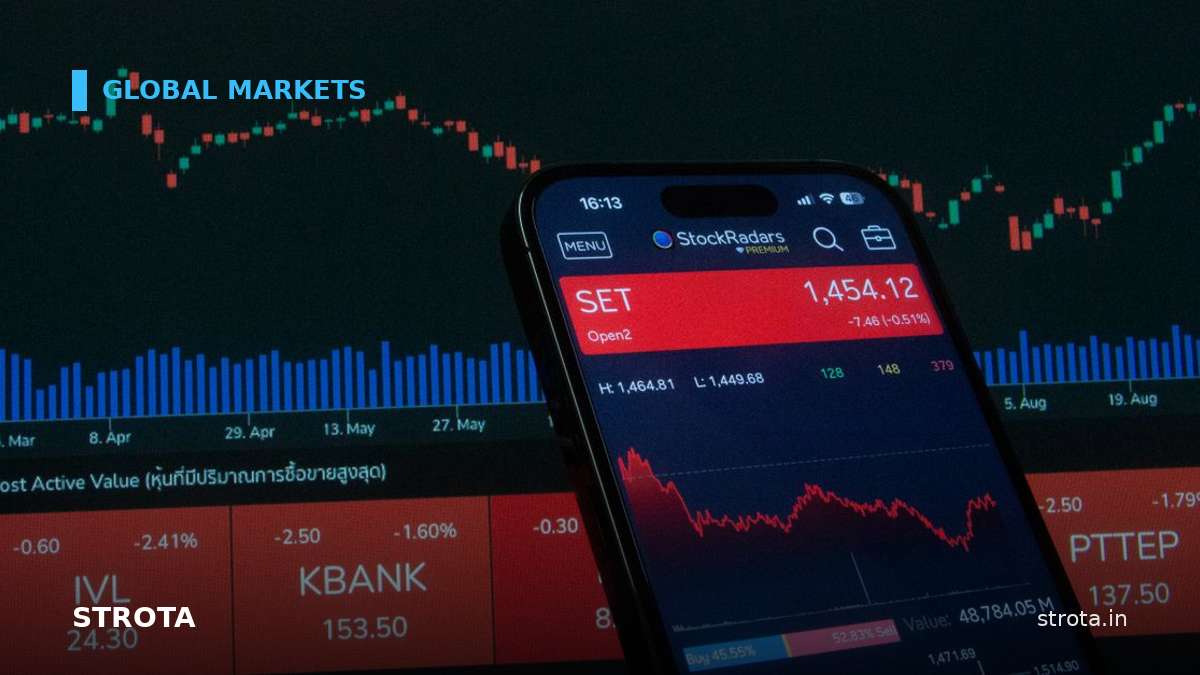
A record plunge in South Korean chip stocks, a $69 billion wipeout at IBM, and oil spiking on Middle East tensions created a perfect storm that tested investors' nerve from Asia to New York.
As U.S. strikes on Iran enter a new phase, investors are watching two markets move in opposite directions — and wondering which signal to trust.
United Airlines just warned of a nearly $6 billion fuel cost hit as oil prices swing wildly on Middle East conflict. Here's why your wallet feels the same turbulence—whether you fly economy or drive to work.
While crude prices surge for a fourth day on supply fears, investors are shrugging off the worst-case scenario—and it reveals something about how we price risk when everything feels uncertain.